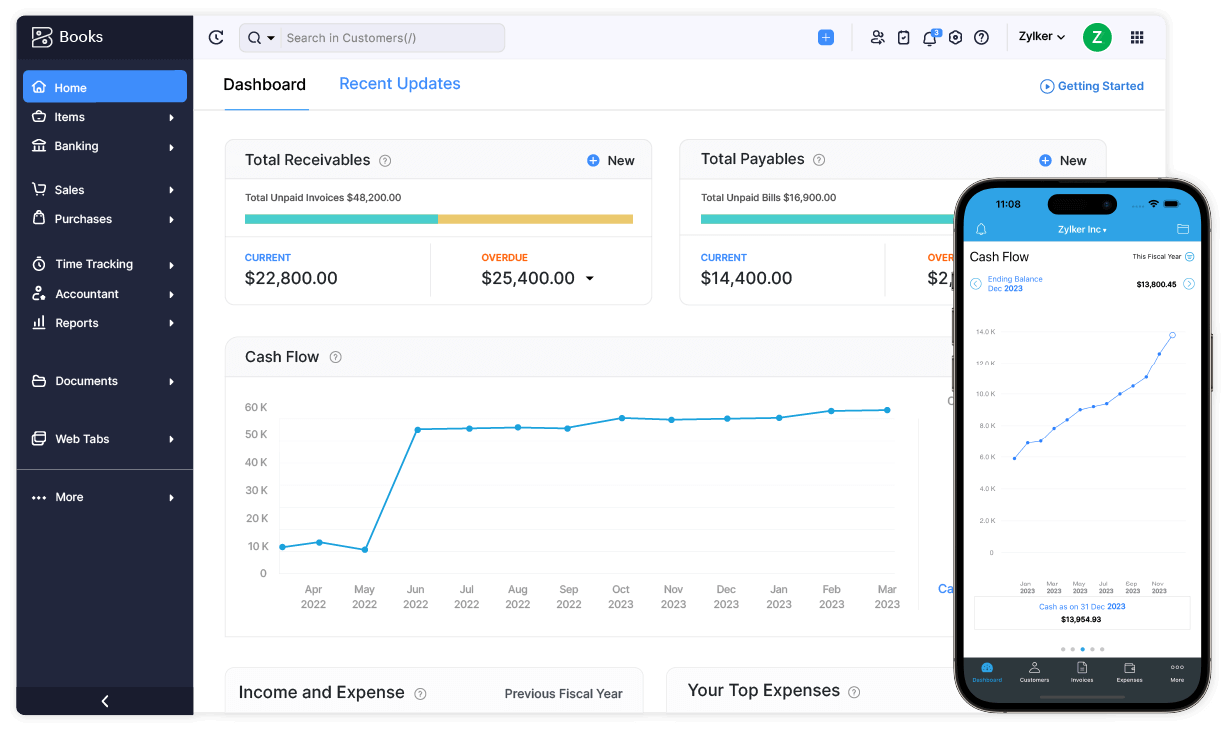
Zoho Books Review 2026
Zoho Books is the accounting module within Zoho’s broader business software ecosystem — which spans CRM, help desk, HR, inventory, email, and 45+ other products. For businesses already invested in the Zoho stack, Zoho Books provides tight native integration that no external accounting tool can replicate.
For standalone accounting, it’s a strong value proposition. For Zoho CRM users in particular, it’s the most logical accounting choice.
Zoho Ecosystem Integration
Zoho’s main competitive advantage is native integration across its product suite:
- Zoho CRM → Zoho Books: Deals won in CRM automatically create invoices in Books. Customer payment history is visible in CRM contact records.
- Zoho Inventory → Zoho Books: Stock levels sync in real time; purchase orders from Inventory flow into Books as bills automatically.
- Zoho Payroll → Zoho Books: Payroll runs post directly to the chart of accounts with correct expense categorization.
- Zoho Analytics → Zoho Books: Advanced BI dashboards pulling financial data alongside sales and operational data in a single view.
For businesses using Zoho CRM (particularly popular in India, the UK, and among mid-market companies), Zoho Books eliminates the integration overhead that comes with connecting QuickBooks or Xero to CRM via Zapier or native APIs.
Feature Depth
Zoho Books covers accounting requirements that some competitors reserve for higher-tier plans:
- Recurring invoices and expenses — all plans
- Multi-currency — Standard plan and above (15-mo)
- Client portal — all plans
- Inventory management — basic level on Standard, full on Professional
- Purchase orders — Professional plan
- Budgeting — Premium plan
- Custom workflow automation — set triggers, conditions, and actions across the accounting workflow
The workflow automation is Zoho’s hidden strength. Rules like “if invoice is unpaid after 7 days, send reminder; if unpaid after 30 days, apply late fee and alert account manager” are configurable in a visual rule builder without coding.
Tax Compliance
Zoho Books has particularly strong compliance features for non-US markets:
- India: Full GST compliance — GSTR-1, GSTR-3B, GSTR-9 filing support
- UK: Making Tax Digital (MTD) VAT submissions
- Australia: BAS (Business Activity Statement) reports for GST
- UAE/Gulf: VAT accounting for GCC markets
For US businesses, standard sales tax reporting and 1099 tracking are covered. US-specific tax complexity (state nexus, e-commerce sales tax) integrates with Avalara and TaxJar.
Pricing
- Free: 1 user, 1,000 invoices/year — limited but real
- Standard: $15/mo — 3 users, unlimited invoices, multi-currency, bank feeds
- Professional: $40/mo — 5 users, purchase orders, project tracking
- Premium: $60/mo — 10 users, budgeting, custom domain
The Standard plan at $15/mo covers the needs of most small businesses — comparable to Xero Starter but with fewer invoice volume restrictions.
When Zoho Books Makes Sense
Choose Zoho Books if:
- You already use Zoho CRM, Zoho Desk, or Zoho Inventory
- Your business operates in India, UK, or Australia where Zoho has strong local support
- You want automation capabilities without paying enterprise pricing
- You want cost-effective multi-user access (3 users on Standard at $15/mo vs QuickBooks’ 1 user)
Skip Zoho Books if:
- Your US accountant exclusively uses QuickBooks
- Your team doesn’t need the broader Zoho ecosystem
- You want the simplest possible interface (FreshBooks or Wave are friendlier)
Verdict
Zoho Books is the best-value accounting platform for businesses in the Zoho ecosystem, and a strong option for international markets where QuickBooks is less dominant. Standalone, it’s feature-rich and affordable — but its full value only unlocks when paired with Zoho CRM or Zoho Inventory.